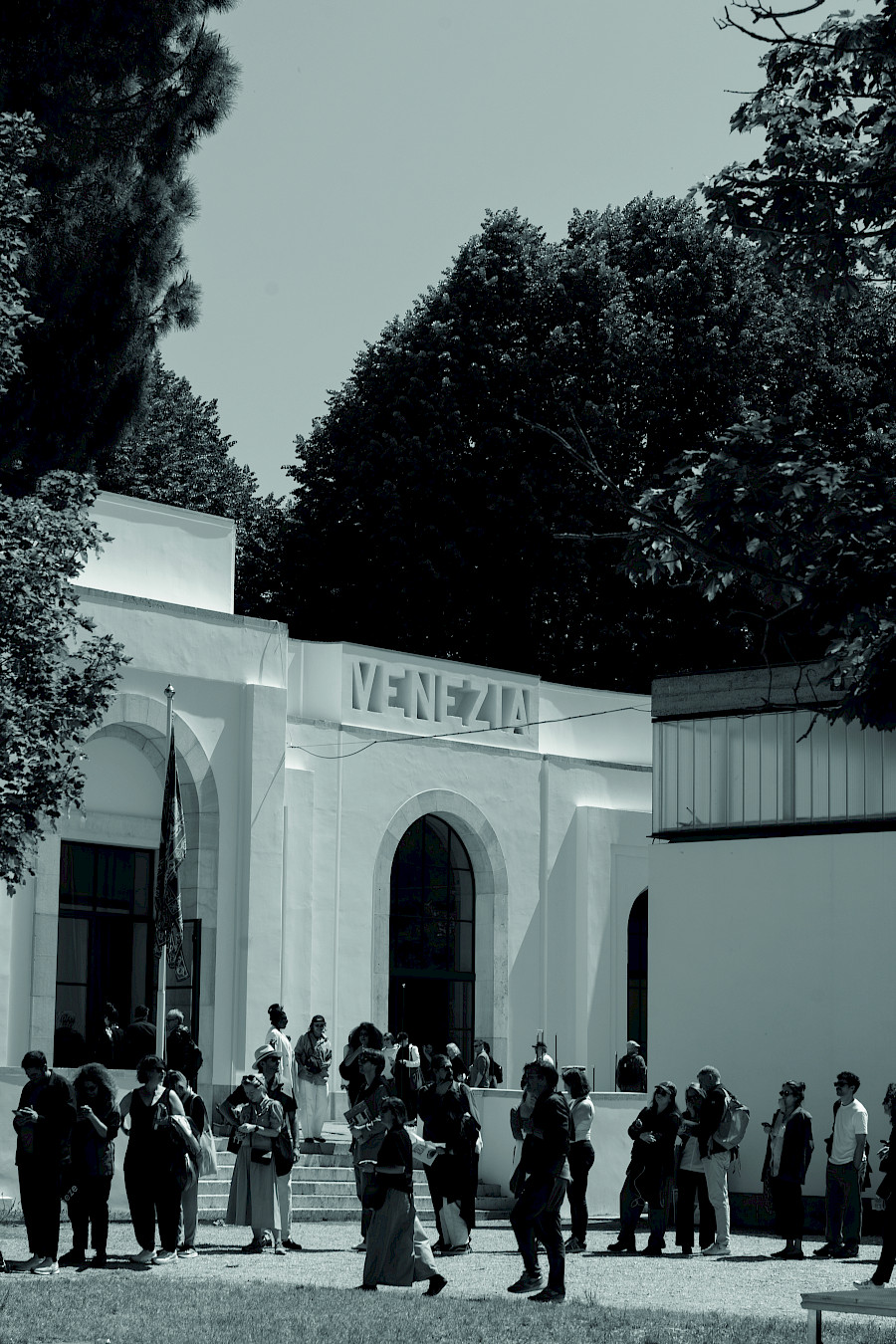
In May, Venice transformed from a poetic city into an extraordinary work of art as the international exhibition, the 61st Venice Biennale – one of the most important and influential events in the world of contemporary art – opened its doors to the public. More than 90 countries are taking part with their national pavilions, alongside around 30 independent art installations – collateral events – spread across the city.
This year’s edition, titled In Minor Keys, was conceived by the late curator Koyo Kouoh and draws inspiration from the Japanese word “komorebi” (木漏れ日). Transience and permanence, nostalgia and quiet joy – these states of the soul were reinterpreted by each artist in their own unique way through their works. We invite all N13 readers to explore the most compelling pavilions – true cultural oases where one can pause and recover from the turbulence of recent months.
We begin our remarkable journey through the world of art with Bvlgari’s exhibition at the Biblioteca Marciana and, of course, cannot resist visiting the Giardini della Biennale, where the jewellery House’s own pavilion, Spazio Esedra, is located among many others.
For the first time in the history of the International Art Exhibition, Bvlgari has become its principal and exclusive partner – a House long renowned for its devotion to art and the freedom of creative expression. This is particularly significant for the Art Biennale, as the Roman Maison has confirmed a long-term partnership with the exhibition spanning three editions. Bvlgari’s presence at the Biennale marks an entirely new and symbolic chapter in the House’s creative expression. For many years, Bvlgari has supported artistic initiatives, viewing art as an act of freedom, while also consistently contributing to the preservation of cultural heritage. This reflects an understanding that knowledge of the past not only enriches contemporary culture but also sustains the innovative spirit of the future. Through this partnership, Bvlgari will continue its presence at the Biennale through 2030 – a commitment that reflects the evolution of the House’s support for the arts and its aspiration to speak a universal language that conveys beauty.
The Fondazione Bvlgari presented its first exhibition as an official collateral event of the Venice Biennale. The project brings together two installations: Momentary Monument – The Library by Lara Favaretto and Fragments of Fire Worship by Monia Ben Hamouda. The choice of the Biblioteca Marciana was far from accidental: the space itself symbolises the preservation and transmission of knowledge. In Monia Ben Hamouda’s work, the “flaming” signs resemble ancient calligraphy that has lost its meaning – a light that conceals history rather than illuminating a new path. By contrast, Lara Favaretto’s installation revives the book as a symbol of preserving and transmitting knowledge across time and generations. The project also includes a series of donations from universities and libraries, intended to explore the multiplicity of ways in which knowledge can be studied and understood. The installation appears as a large contemporary bookshelf placed precisely at the centre of the historic Salone Sansovino, where anyone may approach it, as in an ordinary library, and choose a book to read. The selection criteria were based not on rarity or prestige, but on documentary relevance and authenticity – qualities that allow these books to remain meaningful and useful both now and in the future. It was with this exhibition that the curatorial work of the Fondazione Bvlgari within the Biblioteca Marciana began – a place that itself stands as a symbol of the memory of past generations and the transmission of knowledge to those yet to come.
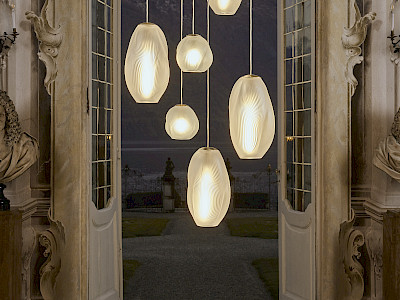
In the Giardini della Biennale, the artist Lotus L. Kang created the remarkable installation The Face of Desire Is Loss for the Bvlgari Pavilion. The work continues her exploration of time as a nonlinear and uncontrollable phenomenon – a form of chaos captured within a specific segment of photographic film. Indeed, the entire pavilion is covered with panels upon which time seems to erase and recreate chaotic images over and over again – images that may continue to shift and transform under the influence of time, temperature, and even the number of visitors passing through the space, right up until the closing of the Biennale.
We continue our journey through the pavilions of different countries, selected by the curator Koyo Kouoh according to her vision of the world as a place where we lose much, experience melancholy, seek comfort in poetic imagery, and live many lives within ourselves and within art.
Beside the Arsenale di Venezia stands the Azerbaijan Pavilion, organised by the Heydar Aliyev Foundation and the Ministry of Culture of the Republic of Azerbaijan, in collaboration with the Azerbaijan National Carpet Museum. This year, Azerbaijan showcases the solo exhibition The Attention by the artist Faig Ahmed, which blends traditional carpet-weaving with science and technology.
Like a guiding thread, an intricate carpet pattern greets us at the entrance and leads us through the rooms of the pavilion. The endlessly fluid lines of Faig Ahmed’s carpets resemble waves of colour, guiding the viewer along a path of discovery – from the external world toward something deeply internal and spiritual. A single carpet transforms from room to room: in one space it becomes a gigantic knot, in another – a fragment of existence itself, and then – a thought, a memory, a form of knowledge. Following the guiding thread of the carpet, like Ariadne’s thread through the labyrinth, each of us travels through our own inner labyrinth of good and evil, encounters the knots of understanding, and finally stands before the quantum random number generator in the hope of receiving a poetic prophecy for our deepest desires. Faig Ahmed admits that he has explored methods of self-discovery since his earliest years. This journey led him to two seemingly opposite realms: the exact sciences on the one hand, and spirituality, poetry, and creativity on the other. Yet art and science do not contradict one another – they complement each other. We are living through a remarkable historical moment in which these two realms are merging into a single system with its own structure and centre of knowledge. Art and science thus merge as complementary parts of a greater whole, together dissolving the boundaries that have long separated them.
Particularly striking is the Italy Pavilion, featuring Chiara Camoni’s work With You, With Everything – a manifesto of solidarity between the artist and the curator, a poetic call for unity. The exhibition takes the form of monumental sculptural figures – “a forest of figures” – inviting the viewer to compare the statues with the human body itself.
The Uzbekistan Pavilion explores the history of the Aral Sea's disappearance not simply as an ecological catastrophe, but as a way of understanding and perceiving the world. The Archive of the Lost Forms by the artist Zi Kakhramonova takes the form of a crystallised-salt labyrinth, within which creatures from the Aral Sea are sealed away. The exhibition also brings together myths of the sea and its inhabitants through the works of Aygul Sarsen, alongside immersive installations by Zulfiya Spowart.
The Kazakhstan Pavilion rises like a monument: a massive architectural structure that serves as an archive of silence, presenting Qoñyr: The Archive of Silence – a tribute to the country’s history and cultural codes.