At the intersection of language, memory, spirituality, and materiality stands the work of Monia Ben Hamouda — one of the most compelling voices in contemporary art today. Drawing on her Tunisian heritage, the visual traditions of Islamic calligraphy, and a profound interest in the structures that shape knowledge and perception, the artist creates immersive works that challenge conventional ways of reading, understanding, and interpreting the world around us.
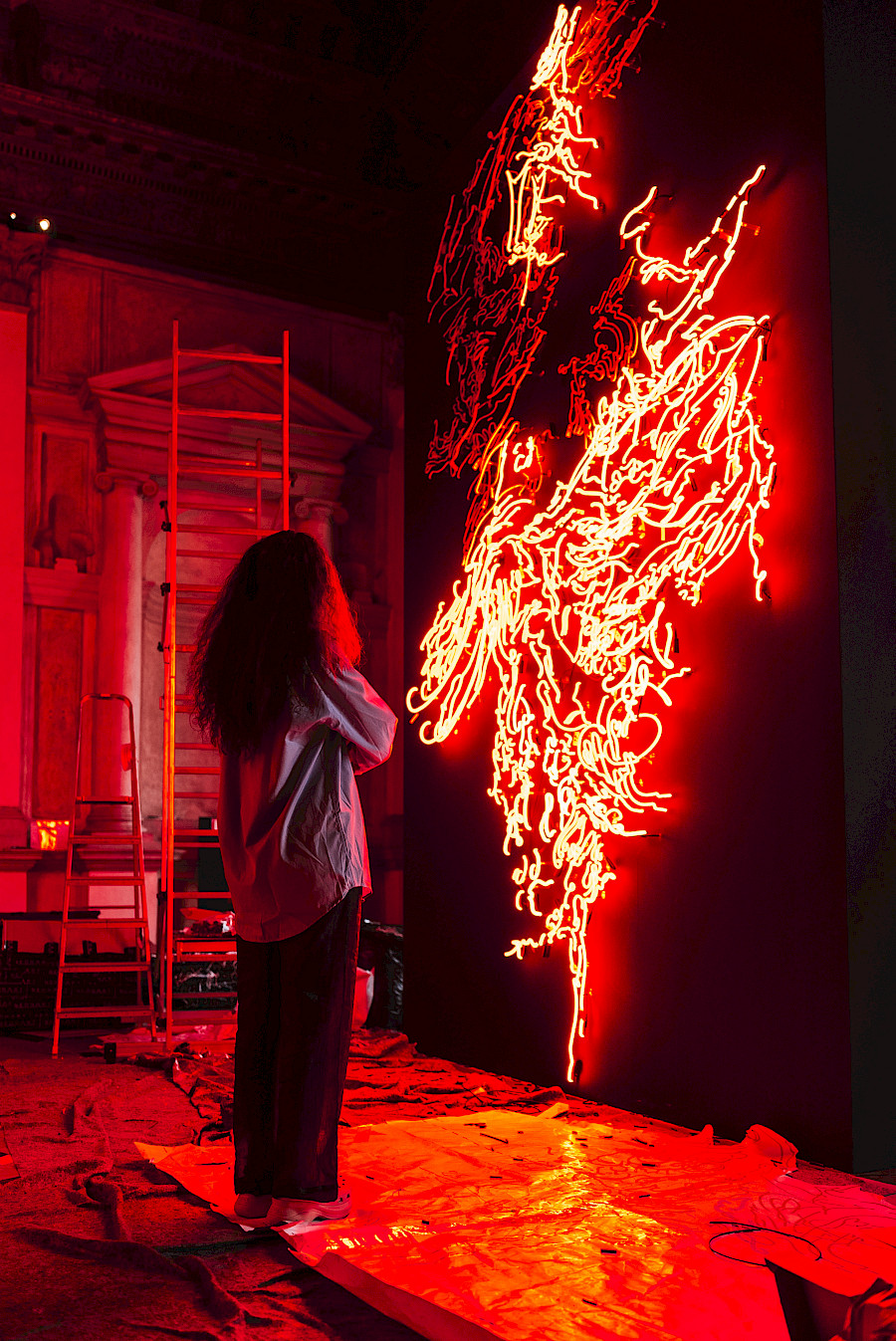
In her latest installation, Fragments of Fire Worship, created for the Biblioteca Nazionale Marciana during the Venice Biennale, Ben Hamouda transforms language into a luminous yet elusive presence — something that invites interpretation while resisting definitive meaning. Her sculptures and installations explore the unstable nature of knowledge, the fragility of cultural memory, and the invisible systems that determine what is preserved, forgotten, or understood.
Following her recent MAXXI Bvlgari Prize and alongside the presentation of Ya’aburnee (Untranslated Fragment I and II) in Milan, Monia Ben Hamouda speaks with Nargis Magazine about inherited histories, abstraction, authority, and the enduring power of what remains untranslated.
Your project Fragments of Fire Worship for the Marciana National Library explores language as a form that has lost its conventional communicative function. What draws you to the space between what can be understood and what remains elusive?
I conceived the work as a controlled contradiction inside an institution built on the promise of permanence. A library is a technology of preservation, and the Biblioteca Nazionale Marciana is an extreme case of that: not only a place where knowledge is stored, but an architectural statement about knowledge as monument.
The building embodies a Renaissance idea of order and rationality, where classification, transmission, and custody are inseparable from power: who can access knowledge, who can interpret it, who can preserve it. What I wanted to introduce into that environment was not an image of fire, but fire as a logic: a force that exposes, transforms, and destabilizes what claims to be fixed.
In that threshold space (the vestibule, the passage before the archive fully begins) I imagined two luminous apparitions of a fragmented language: recognizable as writing, yet not fully legible, activating the impulse to read while refusing the satisfaction of comprehension.
For several years, my work has engaged with language and with the structural impossibility of full understanding: how meaning is never entirely shared, how it slips, fragments, or remains partially inaccessible.
Fragments of Fire Worship extends this inquiry precisely within a space historically dedicated to the stabilization of knowledge. The Biblioteca Nazionale Marciana (and, in another way, the Biennale itself) operates through systems of classification, interpretation, and display. Both are spaces where cultural meaning is organized and legitimized. Introducing a script that appears legible yet resists reading is an attempt to interrupt that logic from within.
When a piece resembles writing but refuses to be read, the viewer’s attention shifts from comprehension to resonance: density, spatial pressure, duration, smell, the room’s temperature. That shift matters to me because it breaks the hierarchy in which language is assumed to be the highest form of knowledge. This opacity is not merely formal; it reflects a broader political and epistemic condition.
The language we inhabit today is already compromised: meanings are continuously negotiated, redirected, instrumentalized, or emptied out while still maintaining the appearance of stability. What interests me are the structures that regulate visibility and intelligibility: how knowledge is filtered, how narratives acquire authority, how certain texts, images, and histories are preserved while others become vulnerable to erasure.
You grew up in the family of an Islamic calligrapher. In what ways do the calligraphy and visual culture of your childhood continue to shape your artistic practice today?
These experiences profoundly influenced how I think about transmission and memory; not as something fixed, but as something unstable, embodied, and continuously negotiated through time. Through calligraphy, writing existed spatially and bodily before it became semantic. I think this profoundly shaped the way I understand images, abstraction, and perception.
My heritage remains a strong influence, profoundly shaping my relationship to language and materiality. I have never understood abstraction as a withdrawal from meaning, but as another way of organizing presence. Calligraphy, in this sense, is never only linguistic; it is also architectural and temporal. My work remains closely linked to these inherited structures.
I also recognize this inheritance in the way I inhabit space. My relationship to architecture often emerges through embodied habits inherited from domestic and religious environments: orientation, emptiness, proximity, and the positioning of bodies and images. These are not references I consciously illustrate; rather, they operate as perceptual structures already sedimented within the work.
That said, I do not approach biography illustratively. I am not interested in translating personal history directly into narrative or identity. I prefer that the personal operates structurally, shaping the internal logic of the work rather than appearing as confession.
Spirituality, cultural memory, and heritage therefore enter my practice less as themes than as material conditions. They influence how I think about language, architecture, perception, ritual, authority, and the instability of meaning itself. I was always very aware of how identities are culturally produced, narrated, and projected; particularly in relation to Arabness, religion, violence, and systems of visibility. My practice does not attempt to narrate identity. It tries instead to expose some of the conditions that produce it, and the tensions that make it unstable.
In your work, writing is often transformed into an abstract sign. Why is it important for you to free language from its literal meaning?
Introducing a script that appears legible yet resists reading is an attempt to interrupt that logic from within. That shift matters to me because it breaks the hierarchy in which language is assumed to be the highest form of knowledge. This opacity is not merely formal; it reflects a broader political and epistemic condition.
The language we inhabit today is already compromised: meanings are continuously negotiated, redirected, instrumentalized, or emptied out while still maintaining the appearance of stability. What interests me are the structures that regulate visibility and intelligibility: how knowledge is filtered, how narratives acquire authority, how certain texts, images, and histories are preserved while others become vulnerable to erasure.
When a piece resembles writing but refuses to be read, the viewer’s attention shifts from comprehension to resonance: density, spatial pressure, duration, smell, the room’s temperature, time. We are again focused on our own perception and not by some sort of external, linguistic, institutional meaning coming from above. We return to a critical, natural posture. We trust ourselves again.
Your works frequently engage with questions of cultural memory and heritage. How do you draw from personal history without turning it into a purely autobiographical narrative?
I try to resist the reduction of my practice as a structure to identity or representation. Personal history and heritage can be read as one of the matrices that traverse my work, but they do not exhaust it. They offer a partial lens, not a total interpretive key.
My work operates through displacement. It takes structures historically tied to devotion, transmission, and authority, and places them in a condition where they can no longer fully stabilize themselves. Art, inevitably, is a product of its time. People sometimes approach artworks through an exoticizing lens because it offers an immediate and convenient explanation for something that appears to depart from the West-centric narratives of art history and contemporary art.
An artwork can operate on several levels, and reaching them requires a certain degree of effort. Personal history and heritage are inevitably present, we are human beings, not neutral entities. But they should not be treated as explanatory shortcuts. When viewers stop at the first available interpretation, that often reveals more about the limitations of their critical framework than about the work itself.
Your practice exists at the crossroads of sculpture, symbolism, and philosophical inquiry. What usually serves as the starting point for a new project: an idea, a material, or an image?
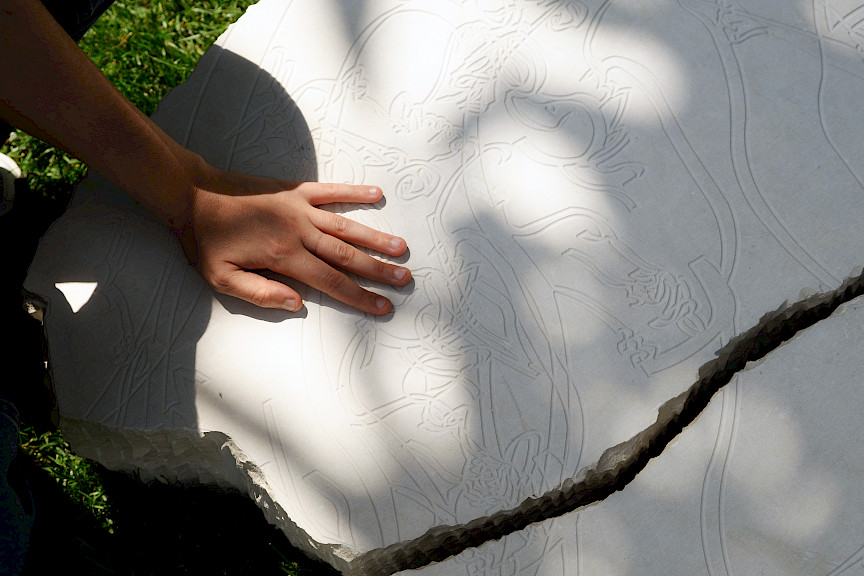
Often, a project begins with a tension rather than with a single idea, material, or image. I may start from a question, but the work only becomes real when I encounter a material or a spatial condition capable of resisting that question.
I am not interested in the relationship between material and meaning in the sense of illustrating something that exists outside the experience of the work. I do not begin from a predefined meaning.
Instead, I choose materials for their capacity to store time and to carry symbols that can be reactivated, often holding strong internal contradictions. What interests me is how matter becomes charged, how it moves from substance to symbol, and how that transformation is never stable or resolved. I am not interested in using materials to illustrate concepts. The process is more reciprocal: an idea produces a material decision, but the material then alters, complicates, or even contradicts the original idea. The final form emerges from that negotiation.
The exhibition describes knowledge as an unstable matter, constantly subject to transformation. Do you believe that the contemporary world is changing the very nature of knowledge itself?
I am not sure the nature of knowledge has changed, but the conditions through which it is produced, circulated, and legitimized certainly have.
Knowledge has always been unstable, partial, and shaped by power. What has changed is the speed of its transformation, the scale of its distribution, and the difficulty of distinguishing between access, repetition, and understanding. Information is increasingly available, but availability does not necessarily produce knowledge.
This makes visible something that was perhaps always true: knowledge is never neutral or complete. It is continuously edited, contested, erased, and rewritten.
Your work often leaves room for interpretation. How important is it for you that viewers discover meanings that differ from your original intentions?
I do not want to prescribe how anyone should interpret what I create. The viewer is never present in my mind while I am working in the studio; it is only me and my obsessions.
Once the work is exhibited, however, it has to exist independently from me. If it can communicate through its own force and generate meanings beyond my original intentions, that is not a loss of control. It means the work has acquired a life of its own, and that is a great joy.
In 2025, you received the MAXXI Bvlgari Prize. How has this recognition influenced your artistic journey and your sense of responsibility as an artist?
The prize gave me greater freedom to work on a more ambitious scale, but it did not change the core of my practice. Recognition brings visibility, but the responsibility I feel toward my work was already there: to remain rigorous, to protect its complexity, and not to simplify it in response to external expectations.
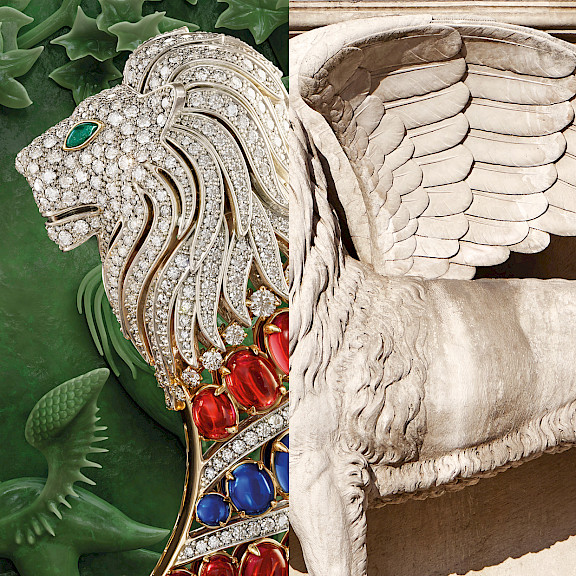
Alongside the Venice Biennale, your sculpture Ya’aburnee (Untranslated Fragment I and II) will be presented in Milan. What connects this work to your new installation for the Marciana Library?
Perhaps what connects the works in Milan and Venice is a persistent condition of partiality: the recognition that no system of language, memory, or history can fully contain the complexity it attempts to organize.
In Ya’aburnee (Untranslated Fragment I and II), this tension emerges through the untranslated: something that survives movement across languages and contexts while remaining partially opaque. In Fragments of Fire Worship, the same instability shifts toward the archive and the architecture of knowledge. The work enters a space historically devoted to preserving and stabilizing meaning, while introducing a language that cannot fully settle into readability.
If you could leave future generations with only one idea through your art, what message would you hope to preserve?
I am not sure there is a message to preserve. At this point, the more urgent question is whether there will be future generations able to receive it. If the world continues along its current trajectory, art cannot simply address the future as if its existence were guaranteed. Perhaps the only idea I would leave is that nothing survives without responsibility: not memory, not culture, and certainly not life itself.
Is there a book, a text, a phrase, or a memory that you return to again and again — something that has, in a sense, become part of your own inner library?
I often return to the prehistoric rock paintings and engravings found in Tunisia, particularly in the pre- Saharan and south-eastern regions. What stays with me is the distance between the permanence of the mark and the complete transformation of the world around it. No one asks these images to explain themselves.