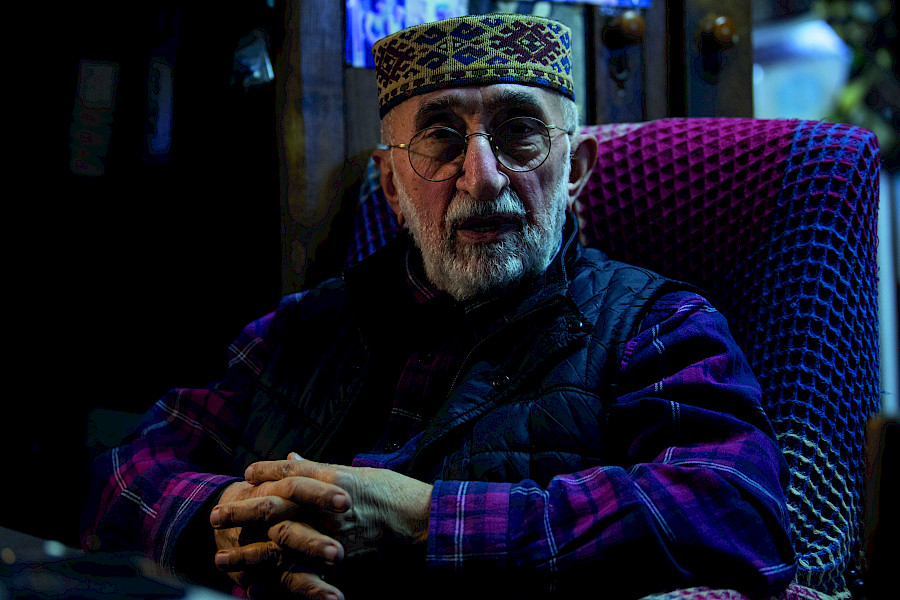
We spoke with a man whose animated films have become an integral part of childhood for several generations. His works are instantly recognisable from the first frames, and his contribution to the development of Azerbaijani animation is immeasurable. Elchin Hami Akhundov – director, production designer, and Honored Cultural Worker of Azerbaijan – is a name synonymous with the golden era of national animation. We discussed how it all began, how animation has evolved over the years, and what continues to inspire the master.
How did you first realise that you wanted to do art?
My father, like any parent, believed that he had an incredibly talented child. And I, like most children, simply drew. When I started attending the Young Pioneer Palace, my first instinct was to join the aircraft modelling club. I’ve always had a love for design and movement, and building model planes seemed exciting. But my father had other ideas. He gently nudged me – orv rather insisted – that I join the art studio instead. I remember thinking ”Why not?”, so I went. And that small decision at the time, turned out to be a turning point. From then on, I began studying art seriously. In the ninth grade, I enrolled in the Azim Azimzade Art School. I studied there with great enthusiasm and graduated in 1968. That same summer, just after finishing art school, I looked for a part-time job. And that’s how I ended up at the film studio. I was drawn to cinema even back then – it had a kind of magic. I didn’t know yet that it would become such a big part of my life. But that was the beginning.
So, why animation? What made you interested in this field?
At the film studio, I first got into a combined workshop, where all sorts of small-scale props and effects were made. Then, in 1964, everything changed. Adil Isgandarov was appointed as the new director of the studio and he brought with him a wave of energy and vision. He was determined to breathe new life into national cinema and invest in young talent. He sent recent theatre institute graduates to Moscow for two- year training programmes; actors to acting courses; directors to directing courses; and even scriptwriters were given the chance to study. He did an incredible amount for the development of national cinema. In 1966, for the first time in Azerbaijan, he launched a two-year course for animation artists. The course was led by Aganaghi Akhundov, himself a graduate of the Moscow animation programme. When he found out I was an artist, he approached me and told me about the new course. He said he was looking for students. I was intrigued – it sounded new, unusual, and exciting. So I signed up. That was the real beginning of my journey into animation.
We studied everything thoroughly – from the mechanics and biomechanics of movement to the principles of residual motion, articulation, and the physics of animation. All according to classical training. And already in 1968, having completed our studies, we created our first colour-animated film – ”Jirtdan”.The film was quite successful – it was screened not only across the Soviet Union but internationally as well. I think the secret was in the style – the production design was inspired by traditional national carpet motifs, which instantly gave the film its distinctive character.
How did your career develop after that?
Afterwards, I enrolled in the graphic design department at the Lviv Polygraphic Institute. Architecture has always attracted me. At first, I studied full-time, but due to family circumstances, I later switched to correspondence courses. All this time, I continued to work in animation. I began as an assistant, gradually moved up to production designer, then to director, and eventually became the artistic director. By the 1990s, I became the director of the studio. To be honest, animation is a kind of illness – in the best sense of the word.
At school, we had classes in monumental painting, and I loved working on large formats. Animation, however, was different – it involved working on small A4 sheets, often lit from below to observe the phases of movement. At first, it felt unfamiliar, and I even considered quitting. But the moment I saw my drawing come to life on the screen, I got sick – and that passion has never left me.
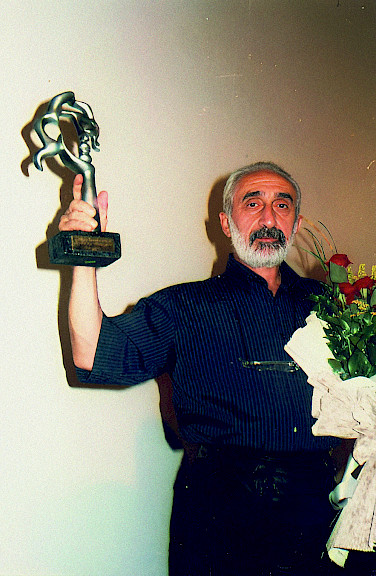
And how did the Azanfilm come into being?
It’s quite an interesting story. Until the 1990s, we were part of the larger Azerbaijanfilm studio – the animation department was just one of several divisions operating under the same roof. Later, Azerbaijanfilm was divided into seven independent studios, and that’s when we established our own – an animation studio. Then came 1991. The Soviet Union collapsed, and with it, all state funding disappeared. We were left to survive on private resources and pure enthusiasm. It was during this turbulent time that I officially founded Azanfilm as an independent animation studio. I came up with the name myself and developed the entire visual identity. From that point on, we operated under the name Azanfilm Studio – and continued creating, despite the odds.
Which of your films is closest to you? Do you have a favourite?
You know, I think I haven’t made it yet. But one that stands out is ”Güzgü” (Mirror), which I made in 1989. It was during the Soviet Union, and it was about Karabakh – a bold choice at the time. The film reflected the pain, the unrest, and the deep fractures running through our society.
Where do you get your inspiration from?
It all comes from God. Everything I have is thanks to Him, and all inspiration comes from above.
What do you think about today’s generation of young animators?
I often say that an animator is an actor – the only difference is that instead of a stage, they have a sheet of paper or a screen. This means they must be able to get into character, feel it with their heart. A good actor has a mirror – he trains expressions, facial movements, gestures – until he truly believes in what he is showing. An animator has the same aim. He needs to understand how the character moves, what he experiences, and how he breathes. It’s not enough to draw well. He needs to live in this image – then the viewer will believe.
So, knowledge of acting is a must for an animator?
Exactly. An animator isn’t just an artist – he’s an actor who draws. He must ”bring to life” the character, to infuse it with soul, emotion, and presence. Just like an actor in theatre or film, he must step fully into the role. Without that depth and sincerity, animation becomes nothing more than empty movement – lifeless and unconvincing.
Were there any funny incidents on the set?
Oh, absolutely! I remember when we were dubbing the cartoon About the Giant Jirtdan in Russian, with the legendary Papanov, Vitsin, and Klara Rumyanova. The sound engineer accidentally mixed up the tracks and completely ruined the recording. We had to find an impersonator to replace one of the voices – it was a challenging experience, but looking back, it turned into one of those stories you can laugh about.
What are your plans and hopes for Azerbaijani animation?
There is so much talent among today’s youth – there’s potential, there’s energy. What they need most is the opportunity to create. Not just one or two films a year, but five, six, ten! Only then will we see true development. Because this is not just art for art’s sake – this is how we educate the next generation, how we preserve our culture, our language, and our identity. But without state support, it simply isn’t possible. We need to be producing 5 to 10 films a year – about our folklore, our traditions, and our language. Today’s children are watching Russian, Turkish, and English cartoons. We are losing them. They’re growing up disconnected from their own cultural roots.
What are you working on today?
In 2016, I met Rashid Agamaliev. Together, we published the first book in Azerbaijan dedicated to the history of our national animation. I served as a consultant – helping with materials and sharing my knowledge.
We spoke about the state of animation in the country, and he suggested holding a festival in Baku. I laughed and asked if we even had any films. He said it didn’t matter – we would invite international filmmakers. And that’s how it all began.
We reached out to the Ministry of Culture and soon held the first ANIMAFILM International Animation Festival. Today, the festival is in its eighth year and takes place every September. Each edition has a different theme – last year, it was Love; this year, it’s Cats. We’ve welcomed participants from the UK, France, Jordan, Georgia, and many other countries. We do everything we can to not only keep the festival alive but to help it grow. Rashid, although now based in the Czech Republic, remains deeply involved in its organisation. Our festival has received qualification status from BAFTA. That’s a major achievement for us. Our next goal is accreditation from the Academy of Motion Picture Arts and Sciences, which would allow us to enter the Oscar race. For the past few years, we’ve been submitting our work to international festivals and competitions – and little by little, we’re starting to get noticed. We’ve also established the ANIMAFILM Animation Centre, where I now teach young artists. I give drawing lessons and lead masterclasses – it’s our way of nurturing the next generation of animators.